Biometrics meets clinical context
Priyanka Agarwal, MD, MBA
I pursued a career in medicine because I believe in the power of the doctor-patient relationship. I built HealthEx because I watched that relationship strain under a health system that asks patients to do too much of the work themselves. It wasn't built for the way people actually live with their health.
In the exam room, I would ask patients about their symptoms, their medications, their history, and they would do their best to remember. Most of the time, the picture was incomplete. Patients were paying close attention, but the system relied on them to be the connective tissue between providers, specialists, pharmacies, and labs that still today don’t talk to each other. Care is too often built on partial information, episodic snapshots, and a lot of work from patients and physicians to assemble a more complete patient record.
Meanwhile, outside the exam room, something remarkable has been happening.
A generation of people are getting serious about their health in ways the system never expected. They track their sleep, their heart rate variability, their training load. They read studies, run their own experiments, asking sharper questions. They know more about how their bodies are responding to daily life than I can see or understand in any single visit.
But when those same individuals walk into a clinical setting, that knowledge often stays on their phone. Their clinical history stays in the EHR. Each lived in its own world.
Closing that gap, and reducing the burden individuals face in navigating their health journey is why I started HealthEx.
A major shift underway
We are at the beginning of a fundamental shift in how health works. Care is moving from reactive to proactive, from episodic to continuous, from system-centered to individual-centered. People are measuring how their body is doing, all on their own, and bringing real curiosity to their health.
But this shift only works when the data follows the person.
If a member can see that their resting heart rate has been climbing for two weeks while their clinician sees only the medication they started a month ago, the picture stays incomplete. If an individual is tracking sleep with extraordinary precision while their bloodwork lives in a portal they barely access, they are still doing the work of integration themselves.
Real progress depends on bringing the biometric layer and the clinical layer together for the person, not around them. That is what makes care feel personal and helps recommendations land. That is what helps the conversation between an individual and their clinician start from a shared understanding, instead of relying on intake forms.
Our partnership with WHOOP
WHOOP has built one of the most engaged communities of health-conscious individuals in the world. These are people who track their health with a level of detail and intentionality clinicians rarely see. They know their patterns. They notice changes. They want their care to reflect what they already know about themselves.
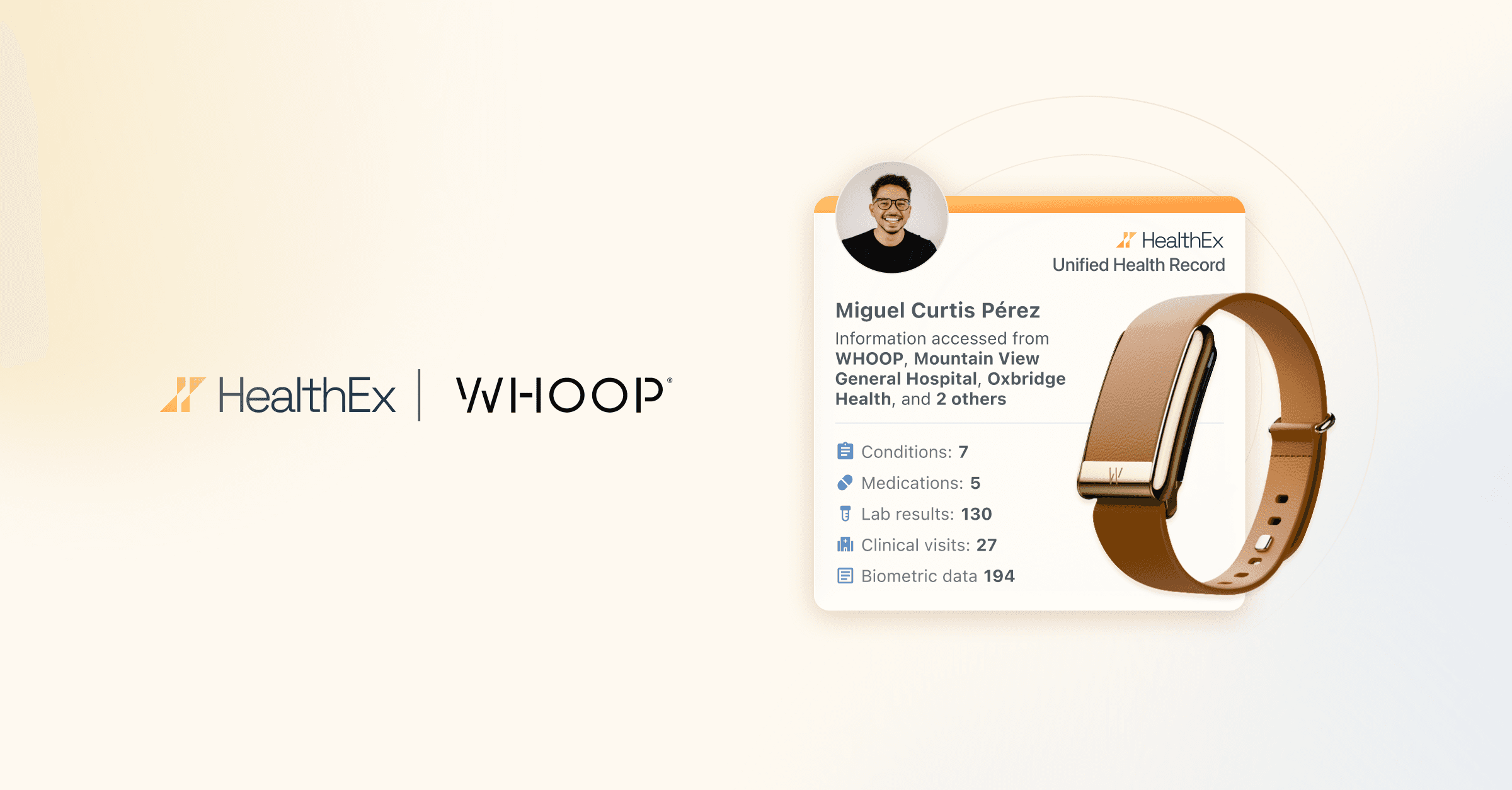
By bringing HealthEx into the WHOOP experience, members will be able to connect their clinical records alongside the biometric data they already trust WHOOP to deliver – all in a single place, on their terms. It’s a step toward a more complete picture of health, and toward the kind of care experience that makes that picture useful and actionable.
Will and the WHOOP team have been some of the clearest voices on the shift toward individual-controlled health. Our two missions sit in the same place: a belief that the individual sits at the center of every decision regarding their care, and that the technology and care teams around them – devices, apps, AI, and the clinicians that support them – work in their service.
Privacy and control are the foundation
Health data is the most personal data we have. Any platform that asks individuals to share it has to start from that reality and design everything around privacy and security, not bolt it on later.
At HealthEx, member control is not a feature. It is the foundation. Members decide whether to connect their records. They can review, modify, or revoke access at any time. The same setup that works in one trusted experience extends, with explicit consent, to others – a portable health wallet members carry with them.
What I hope for
I think a lot about what care could feel like if we get this right and move towards a health system designed around the individual.
I think about the patient with a chronic condition who walks into a visit with their comprehensive medication history already in the room. I think about the parent managing care for a child across three specialists who finally has one place to see it all. I think about the individual who notices a change in their recovery data and brings months of context to their clinician. I think about the clinician who can finally meet a patient with the full picture in hand, ready to use the visit for what matters most.
That future is closer than it has ever been. The technology exists. The infrastructure is being built. The individuals ready to demand it are already here, and platforms like WHOOP are giving them the tools to lead.
This summer, WHOOP members in the U.S. will be among the first to experience what this can look like. We are proud to help power that future. And we are just getting started.